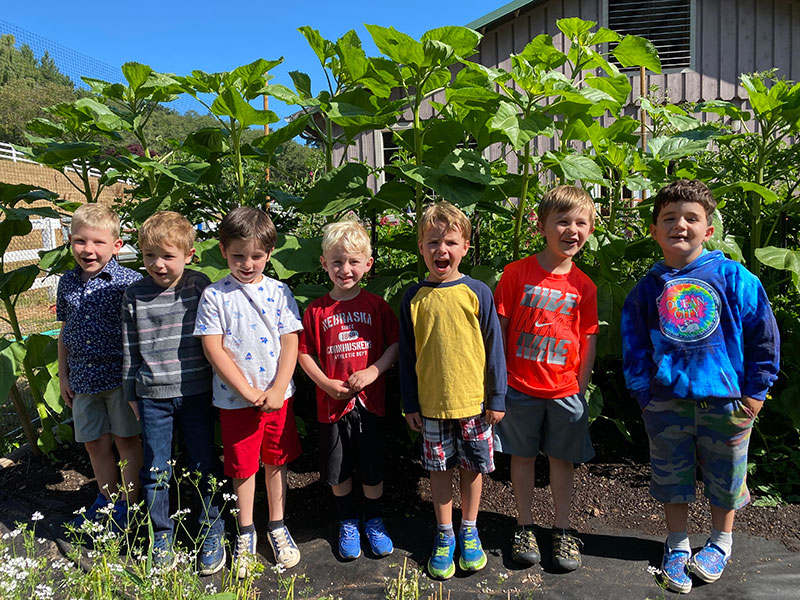
Kids Country Barn’s goal is for each child’s needs to be met. We, as Montessori teachers, meet the child where they are, socially, emotionally, and academically. The following are goals that every staff member strives to achieve with each child: the need for belonging, for freedom from fear, for love and affection, for freedom from guilt, for sharing, for understanding, and knowledge and security.
Dr. Maria Montessori developed the Montessori philosophy and method of educating children. She believed that children learn by actively manipulating interrelated materials and through repetition of movement. The incorporation of the hand and the brain is automatic. She believed that the inherent lesson within the materials becomes a part of the mind. Therefore, the intricate process of the Montessori classroom is successful because of the skillfully developed activities and materials and a particular method of administering them. The foundation of Montessori learning is the practical life section of the classroom. This section is based on everyday activities that help the child develop their small muscle and hand-eye coordination. The activities form the base for the upper level of learning. The other areas of the Montessori classroom are sensorial, language, math, geography, and botany.
The Montessori classroom is set up, so the environment and work control the child’s activity. The child and his or her interests are the next order of priority. The teacher is the facilitator of the environment. After the teacher has established the scope of readiness for each child, individual lessons will be presented. In this way, every child is meeting his or her different potential.
Anti-Racist Curriculum
Our Anti-Racist curriculum aims to instill an understanding of empathy, compassion, acknowledgment, and justice. Through this culturally responsive curriculum, we create a learning environment in which all of our students feel safe, loved, and confident as themselves.
Research shows that teachers do not have as high expectations of students of color, those who are neurodiverse, who come from low-income backgrounds, or those who are emergent multilingual learners. Educational biases cause less rigorous and engaging instruction and harmful inconsistencies in children’s experiences of grade-level content. We continuously examine ourselves as educators and adjust our teaching and materials to ensure they are free of bias, oppression, racism, and underrepresentation.
This curriculum begins with the language, tone, and daily culture of our program. Therefore, our Anti-Racist curriculum starts with the instructional principles of Universal Design for Learning (UDL). UDL gives all students an equal opportunity to succeed because the goal of UDL is to use a variety of teaching methods to remove any barriers to learning. UDL builds in flexibility that can be adjusted for each child’s strengths, passions, and needs, which scaffolds the Montessori classroom. UDL offers curricular flexibility to create culturally responsive, student-centered lessons.
Our Anti-Racists curriculum is built around lessons that combine developmentally appropriate and culturally responsive anti-racism content with academic, social, emotional, and cognitive growth goals to promote learning, joy, wellbeing, and systemic justice for all of our students. We achieve this by grounding our curriculum in students’ everyday realities while investigating local and larger histories to connect abstract social justice ideas to children’s lives.